Drop C Tuning: Notes, Power Chords and the Scales to Learn First

Drop C is one of the most used tunings in heavy music. The open strings, from lowest to highest, are C G C F A D. It sounds dark and dense, and it makes the riffs that define metalcore, metal and modern rock much easier to play.
This guide explains what the tuning is, how to get there from standard tuning, why it changes the way you play power chords, and which scales are worth learning first. Every scale below opens straight in the Lowforge fretboard map, already set to Drop C.
What is Drop C?
Drop C is “D standard” with the lowest string dropped one more whole step. D standard is standard tuning lowered by a whole step (D G C F A D). Dropping the sixth string from D to C gives you Drop C.
| String | Open note | From standard tuning |
|---|---|---|
| 6 (lowest) | C | E → C, down two whole steps |
| 5 | G | A → G, down a whole step |
| 4 | C | D → C, down a whole step |
| 3 | F | G → F, down a whole step |
| 2 | A | B → A, down a whole step |
| 1 (highest) | D | E → D, down a whole step |
How to tune to Drop C
- Start from standard tuning (E A D G B E).
- Tune strings 5 to 1 down a whole step each, to G C F A D.
- Tune the sixth string down two whole steps, to C.
- Use a chromatic tuner and check every string again after a minute or two. Strings stretch after a big change and drift flat at first.
At this pitch the strings have less tension, so they can feel loose and buzz. A heavier string set and a guitar setup check (truss rod, string height and intonation) usually solve it. A guitar technician can advise on the right set for your instrument.
Why power chords get easier
The three lowest strings are tuned C, G, C: the root, the fifth and the octave. That is a complete power chord, so you can press all three strings with one finger (a flat barre) and slide it along the neck:
- Fret 0 (open): C5
- Fret 2: D5
- Fret 3: E♭5
- Fret 5: F5
- Fret 7: G5

In standard tuning the same power chord needs two or three fingers. In Drop C, fast riffs become a matter of sliding one finger, which frees the other hand and the other fingers to play more notes.
What changes on the fretboard
On strings 5 to 1 (G C F A D), the intervals between strings are the same as in standard tuning: a fourth, a fourth, a major third and a fourth. So the scale shapes you already know on those five strings still work, just a whole step lower.
Only the sixth string is different. It sits a perfect fifth below the fifth string, instead of a fourth. In standard tuning the note on the sixth string at fret 5 matches the open fifth string. In Drop C that note is on fret 7. This is the detail that most often confuses players coming from standard tuning, and seeing the notes on the map makes it clear quickly.
The scales to learn first
All of these are rooted on C, the open sixth string. The tool names the black keys with sharps (D# is the same note as E♭), so the notes below appear on the map with the sharp name.
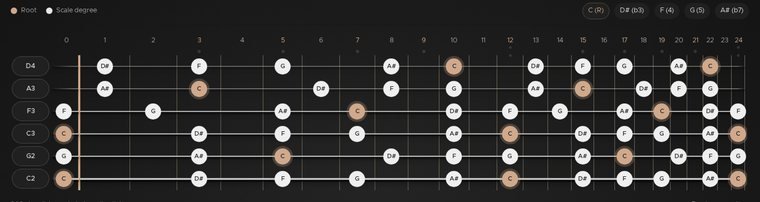
- C natural minor (C D E♭ F G A♭ B♭): the default scale for heavy riffs and the best starting point.
- C Phrygian (C D♭ E♭ F G A♭ B♭): the same as natural minor but with a flat second, which gives the dark, tense colour common in metal.
- C minor pentatonic (C E♭ F G B♭): five notes, easy to play and to improvise with, and the basis of many riffs and solos.
- C blues (C E♭ F G♭ G B♭): the minor pentatonic with one extra passing note, the flat fifth.
- C harmonic minor (C D E♭ F G A♭ B): a raised seventh, for dramatic and neoclassical lines.
- C Phrygian dominant (C D♭ E F G A♭ B♭): a Phrygian scale with a major third, with a strong “eastern” sound.
To see how these scales relate to each other, and which power chords belong to each one, open the circle of fifths for Drop C. It shows the seven chords of C minor or C Phrygian and the fret of each one-finger power chord, and plays common metal progressions in the key.
A 10-minute practice routine
- Scale, 2 minutes. Open the C minor pentatonic exercise, go up and down once, and keep the metronome on. Pick a tempo where every note is clean.
- Power chords, 3 minutes. Practise the power chord exercise, sliding one finger and muting the other strings.
- Chugs, 3 minutes. Play the 3-3-2 chugs on the open sixth string with your picking hand muting the strings.
- Improvise, 2 minutes. Switch on the Improvisation backing track in the tool, with drums, bass and guitar, and play the minor pentatonic over it.
When an exercise feels easy, raise the tempo by 5 BPM. A clean exercise at a lower tempo is worth more than a messy one at a faster tempo.